Q. 82: How does the ‘crossover depth’, involving magma density, inhibit flow in the mantle today?
CPT Q. #82 – 101 Q&A on Catastrophic Plate Tectonics
Question: 82. Does the existence of a ‘crossover depth’ (which some creationists claim prevents magma from rising above this depth in the mantle) falsify the idea of upward and downward flow in the mantle?
Response: First, let me try to dispel a widespread misunderstanding about the state of rock inside the earth, namely, that it is not magma!! Except for some extremely tiny pockets near the earth’s surface, near the core-mantle-boundary, and possibly just above the top of the transition zone at 410 km depth, mantle rock is solid, not liquid! Again, the mantle is not comprised of molten magma! This basic reality has been confirmed over and over again by seismology on a daily basis for almost the last 100 years. How? By the fact that the rocks essentially everywhere within the mantle propagate shear waves, or S-waves. Because liquids do not support shear stresses, they cannot support S-waves. In fact, the way we infer with confidence that the outer core is molten is from repeated observations that no S-waves propagate within it. But S-waves do propagate throughout the earth’s rocky mantle. Hence, it cannot be molten and liquid.
Because the mantle is solid essentially everywhere, the ‘crossover depth’, which pertains to magma, is largely irrelevant as far as the present earth is concerned. Subduction zones, beneath mid-ocean ridges, and just above the core-mantle boundary are the three places where small amounts of melting of mantle rock is known to take place in the earth today. Melting can occur in a subduction zone as the top side of the subducting slab reaches about 100 km depth and encounters what is called the mantle wedge below the overriding plate. The high temperature of the mantle wedge causes the rock on the top side of the subducting slab to give up its water. This water lowers the melting temperature in the mantle wedge rock, often by a sufficient amount for partial melting to occur and basaltic magma to form. This is basically the cause for the ‘Ring of Fire’ volcanism inboard of the subduction zones around the Pacific Rim today.
Partial melting of mantle rock also occurs beneath mid-ocean ridges, where divergence of the plates from the ridge axis causes solid hot rock to rise up from below to fill the resulting gap. Rock melting temperature decreases with decreasing pressure. As rock rising beneath a spreading ridge experiences lower and lower pressure, some of its minerals find themselves above their melting temperatures. When this happens partial melting begins and basalt magma forms. This is called decompression melting. It occurs at depths typically between 50 and 120 km below spreading ridges.
Partial melting in a very thin layer in certain patches just above the core mantle boundary seems to be the explanation for the so-called ‘ultra-low velocity zone’ (ULVZ) discovered by seismologists about ten years ago. The only other place in the mantle where melting has been hypothesized to occur is immediately above the top of the transition zone at about 410 km depth. If melt does exist there, its volume is inferred to be small. Other than for these special situations, in subduction zones, beneath mid-ocean ridges, immediately above the core-mantle boundary, and possibly just above the top of the transition zone, rock in the mantle is below its melting temperature and therefore a crystalline solid.
What then is meaning and significance of the ‘crossover depth’? In the article referenced by Walt Brown in his book In the Beginning, 8th ed., the crossover depth is defined as the depth below which the density of liquid basaltic magma exceeds that of solid olivine crystals. The 2006 article is posted at http://www.spring8.or.jp/pdf/en/res_fro/06/113-114.pdf. It is by S. Urakawa, T. Sakamaki, and E. Ohtani and entitled “Anomalous compression of basaltic magma: Implications to pressure-induced structural change in silicate melt.” This is simply a web-posted preliminary research report. Based on extrapolation of their actual measurements, they estimate that melt density crossover occurs at a pressure of about 7 GPa, which corresponds to a depth in the earth of about 215 km. A better and more recent article describing similar results is by C. Agee and entitled “Static compression of hydrous silicate melt and the effect of water on planetary differentiation,” Earth Planet. Sci. Lett. 265, 641–654, 2008. Agee’s experiments show a density crossover at about 9 GPa between olivine and silicate liquid with 2 wt.% water. The pressure of 9 GPa corresponds to a depth in the mantle of about 270 km.
In regard to the meaning and significance of these experimental results, the researchers in this field generally relegate their relevance to the era immediately after the earth’s formation, when they conjecture that much of the mantle was molten as a ‘magma ocean’. In an article entitled “Melting relations and the equation of state of magmas at high pressure: Application to geodynamics,” Chemical Geology 265, 279-288, 2009, the author E. Ohtani states,
The melting relation of minerals and the equation of state of magmas are important properties for deducing the formation and differentiation of the Earth, and especially for elucidating the nature of the terrestrial magma ocean and the subsequent formation of the core, mantle, and crust of the Earth. Because these magmas are compressible, we expect that the olivine–magma density crossover played an important role in controlling the geochemical characteristics of the primitive mantle after the magma ocean stage of the primordial Earth. (emphasis added)
The crossover depth, as these authors repeatedly stress, has applicability to the very early part of earth history when they hypothesize that the mantle was largely if not completely molten! In their framework it pertains to that brief era in earth history before the earth’s granitic crust had been chemically differentiated from the mantle. This state of affairs certainly does not apply to the present earth. Nor, so far as I can tell, does it pertain to the earth since God created it and filled it with life during Creation Week, including the Flood.
The only contexts in which the crossover depth plays a role in the present earth are the small regions in the mantle below about 250 km where melt may exist, that is, just above the core-mantle boundary and just above the transition zone at about 410 km depth. In the thin patches known from seismology as ‘ultra low velocity zones’ just above the core-mantle boundary, the dense melt is presumably trapped against the denser core beneath it. The situation at 410 km is more complex. The figure below from the paper by Ohtani is provided to help explain it.
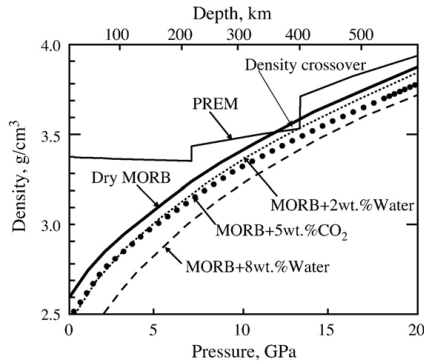
At these depths, water and carbon dioxide can reduce the melting temperature by 200-400°C, plausibly sufficient to produce partial melting. So if there is sufficient water and/or CO2 present to cause melting near 410 km depth, it appears to be at least possible for the magma to have comparable density to the solid phase minerals and thus form a thin gravitationally stable layer. (Such a layer is stabilized from sinking deeper because of the higher density of the transition zone region beneath it.) But it is far from certain that such a layer actually exists, at least in any widespread way, although there is some seismic evidence that it may be present in regional patches.