Q. 91: How do overthrusts occur and folded mountain ranges arise?
CPT Q. #91 – 101 Q&A on Catastrophic Plate Tectonics
Question: 91. Do overthrusts and folded mountain ranges represent features that conventional geology cannot explain? Walt Brown is convinced that overthrusts are not possible. I see problems with the conventional view of how mountain rock layers got to be folded. (It is claimed that the layers were once at great depth, but how and why would sedimentary rock ever be at great depth?) Please provide your view on these issues.
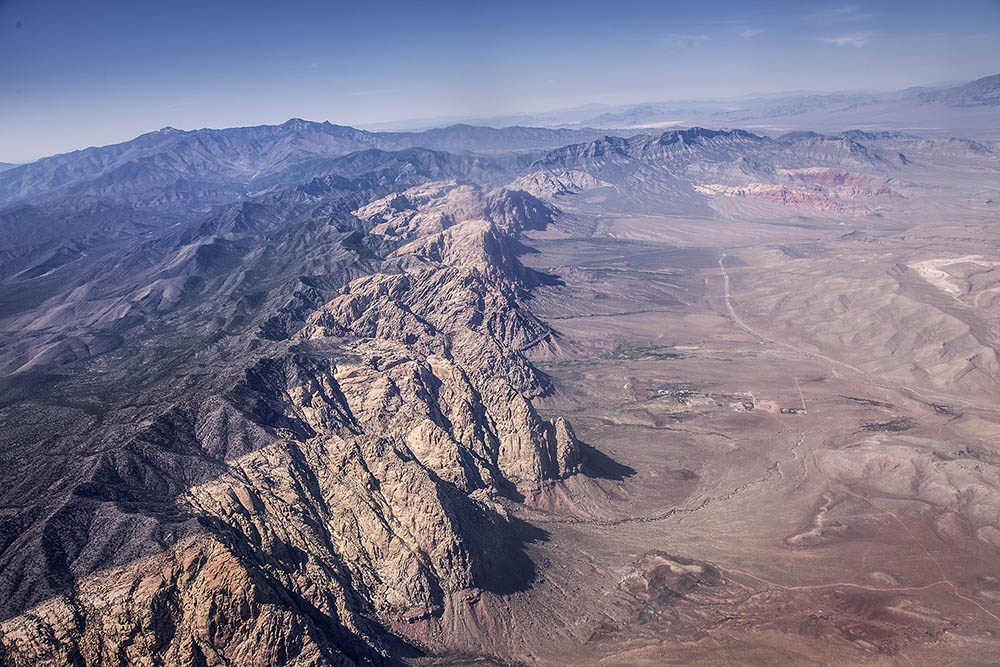
Response: Let me begin by discussing overthrusts. Overthrusts are real. As an example, I would point to the Keystone Thrust just west of Las Vegas, Nevada shown in the photograph below, which I am reproducing from my answer to question 30. The Keystone Thrust represents a horizontal displacement of a sheet of rock by several tens of kilometers. Most of the displacement occurred in the late Cretaceous when the Farallon slab was subducting horizontally beneath western North America.

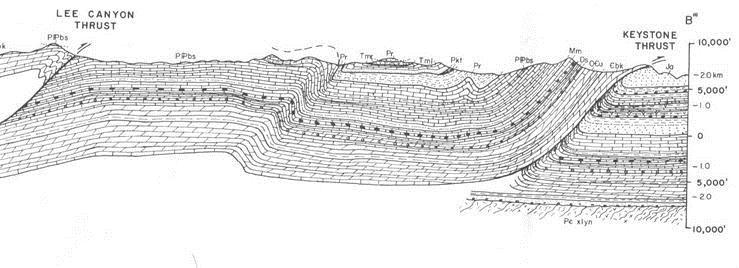
Below is a cross-sectional view of the Keystone thrust sheet, some 13,000 feet in thickness. Along its eastern edge, its basal layer of Cambrian Bonanza King Limestone now lies on top of Jurassic Aztec sandstone, which is some 15,000 feet higher in the regional sediment sequence.
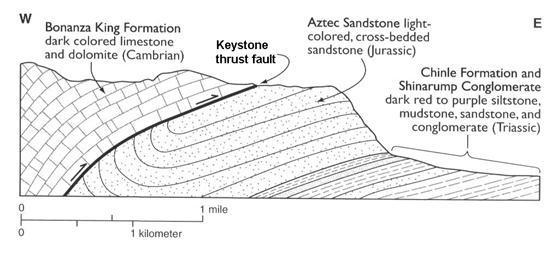
Below is a simplified version of this same cross section.
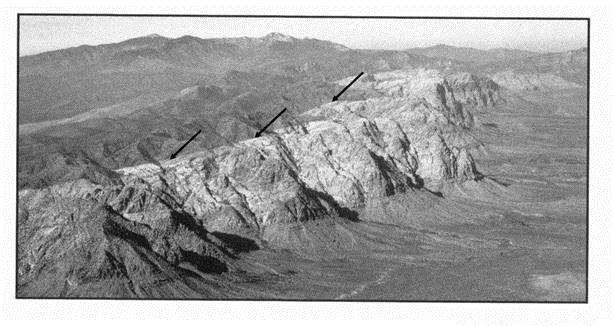
Below is another aerial photo showing the fault contact a bit better than the previous color photo.
A simple analysis shows that pushing such a massive sheet of rock from the side is not a viable possibility. Rock simply does not have sufficient compressive strength to support the edge forces required. The only type of force capable of accomplishing such a mechanical feat is a body force. The main two candidates are gravity and inertial deceleration. Gravity sliding in response to tectonic deformation of the earth’s surface seems to be the most plausible choice. The figure below attempts to illustrate how gravity sliding in response to tectonic uplift of the western margin of North America associated with the rapid subduction of the Farallon Plate may have produced the complex pattern of imbricated fault sheets and spectacular folding observed, for example, in the Canadian Rockies.
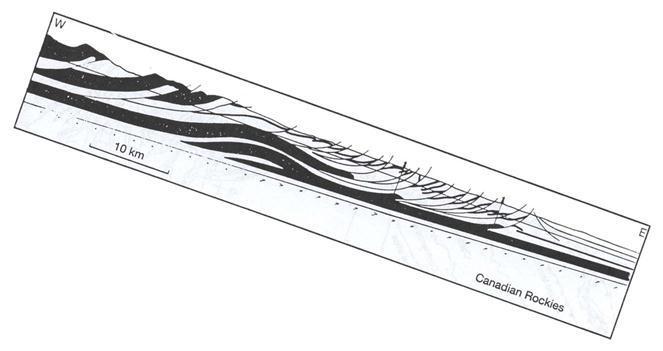
This is how I would account for such features that are moderately common in the world’s tectonic belts.