Q. 93: Can you provide references that support your lower mantle seismic tomography image?
CPT Q. #93 – 101 Q&A on Catastrophic Plate Tectonics
Question: 93. I am finding it difficult to confirm the basic features in the seismic tomography image you used in your response to question 19. In fact, I found two papers that seem to contradict your image. One paper is “Evidence for deep mantle circulation from global tomography,” by R.D. van der Hilst, S. Widiyantoro and E.R. Engdahl (Nature, 386, 578-584, 1997). This paper does not seem to show any plume rising under Africa, nor a hot plume in the middle of the Pacific. Another paper is “Degree 12 model of shear velocity heterogeneity in the mantle” by Wei-jia Su, Robert L. Woodward, and Adam M. Dziewonski (J. Geophys. Res., 99, 6945-6980, 1994). This article also seems to show no rising plumes under Africa nor beneath the mid-Pacific. Please resolve this apparent conflict.
Response: Let me reproduce the seismic tomography image to which you are referring.
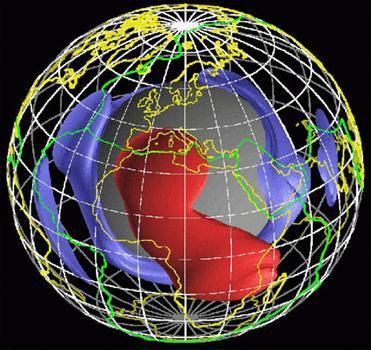
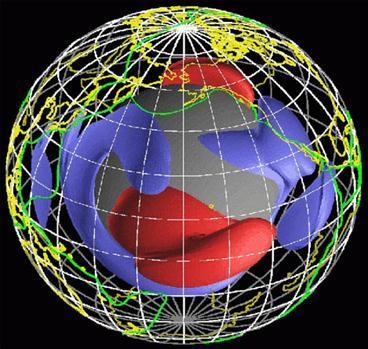
The 1994 paper by Su, Woodward, and Dziewonski most definitely emphasizes these features and even refers to them as “megastructures.” In the abstract of the paper one finds the statement, “The model is dominated by a few megastructures of velocity heterogeneity below the depth of 2000 km, in agreement with previous studies. Among these megastructures are the ‘Pangea Trough,’ ‘Great African Plume,’ and ‘Equatorial Pacific Plume Group.’” The ‘Pangean Trough’ to which they refer is the ring of cold material at the bottom of the mantle that lies roughly below the perimeter of the Pangean supercontinent as indicated in the image above. The ‘Great African Plume’ and the ‘Equatorial Pacific Plume Group’ correspond to the two red features in the image. These megastructures to which Su et al. refer are evident in their Figures 5(l), 7, and 21. In discussion of Figure 21, the authors state,
The largest of negative anomalies in the lowermost mantle: the ‘Great African Plume’ is shown at the CMB depth in Figure 21c. It demonstrates a ‘connection’ to the Mid-Atlantic Ridge as well as to the Mid-Indian Ridge. The mantle between the East African Rift and a point just west of Australia is slower than normal down to 1500-2000 km depth. One of the corners of the final panel, Figure 21d, is centered on the middle plume of the EPPG and shows how strongly it affects the velocities (and the temperature field) under the South Pacific. Also shown is an extensive low-velocity column under the southeast Indian Ridge and a part of the ‘Tethys Trough,’ a high velocity megastructure extending from Gibraltar to the Macquarie triple junction.
Finally, in the last paragraph, as a final point of emphasis in the paper Su et al. state, “The clearest and most robust features of model S12 in the lower mantle are several very large-scale anomalies (megastructures or”grand structures”), whose locations and extent are consistent with the results obtained in previous studies [Dziewonski et al., 1991, Dziewonski and Woodward, 1992].”
In regard to the paper by van der Hilst et al., the focus is on accurate imaging of subducted slab material. In contrast to the Su et al. study, which used S-waves, the van der Hilst et al. paper employed P-waves, which do not capture the features at the bottom of the mantle as strongly as S-waves do. Nevertheless, these features are present in their Figure 1(f). They allude to them in their abstract as “long-wavelength heterogeneity near the core-mantle boundary.”
The two low seismic velocity features displayed in red in the seismic tomography image shown above have recently received widespread attention in the earth science community. They are now referred to as ‘large low-shear-velocity provinces’, or LLSVPs for short. This term was introduced in 2008 by Ed Garnero and Alan McNamara in a Science paper entitled “Structure and Dynamics of Earth’s Lower Mantle,” (http://www.mantleplumes.org/WebDocuments/Garnero2008.pdf). Concerning these features they state in this paper:
Seismic data suggest that two broad regions with lowered shear-wave speeds and higher than average density lie beneath the Pacific and Africa. The African anomaly appears to extend upward from the CMB about 1000 km, whereas the height of the Pacific anomaly is less certain but probably at least 400 to 500 km. Each anomaly is about 15,000 km across, and together they cover nearly 50% of the CMB. The boundaries between these large low-shear-velocity provinces (LLSVPs) and normal mantle are sharp, as implied by seismic waves that graze LLSVP edges.
The figure below is from a PowerPoint presentation on LLSVPs by Bernhard Steinberger, entitled “Large Low Shear Velocity Provinces in the lowermost mantle and Plume Generation Zones at their margins” available at http://www.geodynamics.no/STEINBERGER/papers/talk_ntu.ppt. This figure highlights the observation that most of the world’s hotspots and what are called ‘large igneous provinces’, when mapped back to their locations when they erupted, lie along the margins of these two LLSVPs.
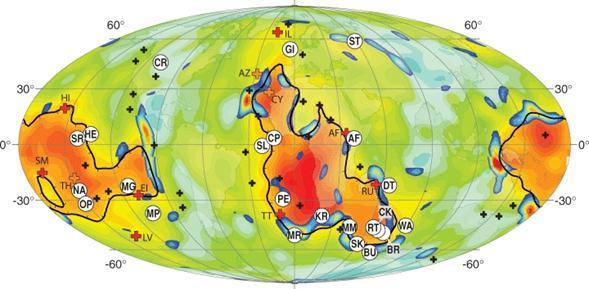
So there is now no doubt concerning the reality of these megastructures at the base of the mantle. However, so much attention is now being focused on the LLSVPs that most people in the uniformitarian community seem to be largely ignoring the fact that the high shear wave speed of the material in the so-called ‘Pangean Trough’ is implying anomalously low temperatures for this subducted material. Of course, I have been using the extremely low apparent temperature of this material to argue that its subduction must have been recent.