Q. 96: What evidence might exist that the Earth flipped like a top several times during the Flood?
CPT Q. #96 – 101 Q&A on Catastrophic Plate Tectonics
Question: 96. What might constitute observational geophysical evidence of rotational changes of the earth? Do you believe there is such evidence? Could curvilinear fracture zones be something that would give clues about rotational axis changes of the earth, or would the effects of it be more in the mantle?
Response: If the earth truly experienced rotational instability during the Flood similar to what I have suggested, there ought to be some clear physical evidence to support this fact. Your question prompted me to add some new diagnostics to the computer code I had originally developed to study these rotational mechanics issues. The new diagnostics output the actual acceleration field over the earth’s surface which would have been acting on the surface rocks during the interval of rotational instability. What I found was that the accelerations at the earth surface were as large as 1.8 x 10⁻⁶ m/s2 in amplitude, or about 1.8 x 10⁻⁷ times the acceleration due to gravity.
The total force arising within a plate as a consequence of this acceleration field is the integral of the local acceleration times the rock density over the volume of the plate. To estimate the stress level on a specific plate boundary, one must apportion the total force acting on each of the two adjacent plates to the boundary segment in question, take the vector difference of the apportioned forces, and divide by the area of the boundary. If one were to ignore the actual pattern of accelerations and assume that at least in some cases the forces on adjacent plates might be nearly opposite in direction, one can obtain stress levels on the order of 2 x 10⁷ N/m2 or 20 MPa, which is not that far from the 100 MPa estimated to be the limiting stress value on many of the deforming plate boundaries on the earth today. However, the pattern of accelerations I observe is very smooth, essentially that simply of a changing the rotation rate for a spinning rigid body (as one should expect). In other words, there are no abrupt changes in acceleration anywhere on the sphere, and hence the stresses on the plate boundaries must be close to zero. From this I conclude the effects of unstable rotational behavior were probably negligible on the orientations of fracture zones and ridge axes during the Flood.
However, another type of geophysical observational data that already seems to be lending a measure of support to this sort of rotational instability is what is referred to as the virtual geomagnetic pole (VGP) paths. In the early 1990’s it was found that patterns of paleomagnetism recorded in oriented grains of magnetic minerals in sediment cores seemed to be indicating that, within the intervals during which the earth’s magnetic field had reversed its polarity in the past, the magnetic poles usually followed similar paths along the same preferred meridians, 180° apart, as shown in the histogram below.
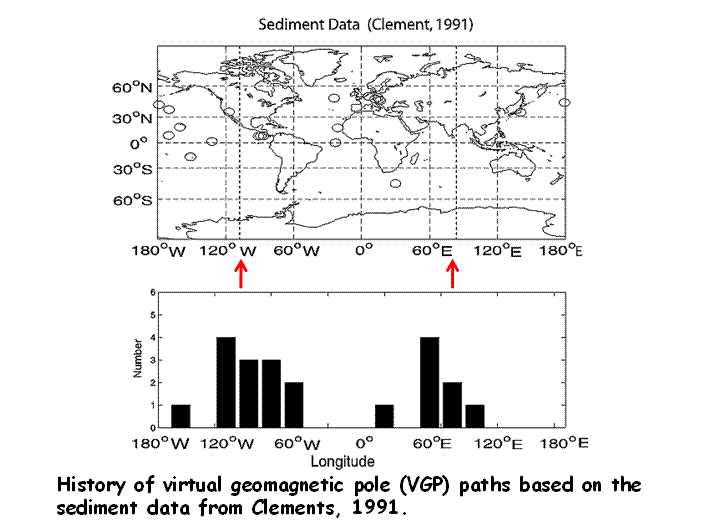
What is truly noteworthy about these data is that these preferred longitudes basically conform to the great circle, through the North and South geographic poles, which enclosed Pangea and also corresponds to the circle of subducted cold rock at the base of the mantle as revealed by most global seismic tomographic models. When a ring-shaped density anomaly aligned with this great circle is used to drive the rotational instability proposed for the Flood, the resulting motion of the earth’s North and South geographic poles conforms precisely to this same great circle! Although all these things could be coincidental, I doubt that they are. Despite the huge amount of effort which would be involved, further investigations of the magnetic record in sediments from more locations around the world could shed some very significant new light on the locations of the magnetic poles as a function of time. Should such studies reveal that the magnetic poles were migrating along this great circle path, not just during brief episodes, but continuously through most of Phanerozoic history, this would provide stunning confirmation for rotational instability during the Flood and for the Flood itself.
Finally, the type of modeling work I have just barely begun in exploring the patterns of currents on the continents that arise from the forcing the rotational instability exerts on the water in the ocean basins could also conceivably provide some powerful confirmation. This is a daunting task, but a gifted young scientist who is called of God potentially could make a huge contribution to our understanding of the Flood by showing that actual sediment distributions can be explained by the large-scale water currents this mechanism generates.