Q. 99: How and when did the thick Precambrian Belt Supergroup sedimentary rocks form?
CPT Q. #99 – 101 Q&A on Catastrophic Plate Tectonics
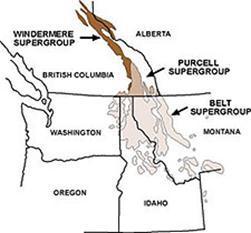
Question: 99. Massive, thick deposits of sediment occur in a variety of places over the earth that are difficult to explain. Rocks fitting this category include the Belt Supergroup of Montana. Here is a set of rocks described as being part of Mesoproterozoic sequences. For many creation geologists these are considered to be part of the pre-Flood rock accumulation. One reason given for this conclusion is that these sediments contain no fossils. However, the Belt Supergroup represents an accumulated thickness of sediments up to 18,000 - 20,000 meters (http://en.wikipedia.org/wiki/Belt_Supergroup). Much of the deposit is composed of fine-grained sands or mudstones with laminations only millimeters thick. Please explain how such sedimentary formations originated, according to your understanding, either during or prior to the Flood.
Response: As I have made clear in my answers to several of the previous questions, I am persuaded by the research of the RATE team that radioisotope dating methods do, as a general rule, give reliable relative dates for igneous and metamorphic rocks. What is the logic behind such a conclusion? Very briefly, the RATE research, which included more than a thousand radioisotope analyses on a very wide assortment of rock samples showed, with little room for uncertainty, that—not a little—but a vast amount of nuclear decay has occurred within the earth’s rocks since the earth was originally created. There is also an unmistakable pattern that the higher an igneous intrusion or a volcanic tuff bed occurs in the geological record, the smaller are the levels of nuclear decay products it contains. Because of this pattern of diminishing levels of nuclear decay products as one moves upward through the geological record, confirmed with such vast numbers of rocks and radioisotope measurements, it is possible to apply radioisotope methods to determine with a reasonable level of confidence the relative timings of when various igneous intrusions occurred and tuff beds were deposited.
Applying this approach to the Belt Supergroup rocks, in my opinion one must conclude that this extraordinary sequence of sedimentary rocks must have formed prior to the Flood. This conclusion, of course, relies on an assumption regarding the point in the rock record that marks the onset of the Flood. To me that golden spike must correspond to that well-acknowledged abrupt first appearance of multi-celled organisms, which also coincides with a widespread physical unconformity in the rock record. This stratigraphic and paleontological boundary occurs at the base of the so-called Ediacaran layers. Igneous intrusions localized to this point in the record yield radioisotope ages of about 580 Ma. Therefore, radioisotope ages of igneous intrusions in Belt Supergroup rocks in the range of 1400-1470 Ma logically place the deposition of these rocks prior to the onset of the Flood.
To me the only feasible time these sediments could have been deposited in the framework of the history of the earth given in Scripture is during Creation Week prior to the creation of plant life on Day 3. There are several reasons why I conclude that deposition of the Belt sediments must occur during the early part of Creation Week and not in the interval between Creation Week and the Flood. One is that 900 million years’ worth of nuclear decay (i.e., 1470 Ma - 580 Ma) at present rates unfolding during the short span of time between creation and the Flood would have devastating consequences for all living things on earth. Next, the amount of large-scale tectonic changes that occurred during the interval in the rock record between 1470 Ma and 580 Ma compare with, if not exceed, those of the Flood itself. Those catastrophic changes logically must be associated with the events during the early part of Creation Day 3. Scripture gives no hint of such catastrophism in the interval between Creation and the Flood.
I therefore interpret the Belt Supergroup rocks as sediments which were generated in the process of God’s fashioning the earth as a suitable habitat for the life forms He created during the remainder of Creation Week. Certainly, God’s declaration on Day 3, “Let the waters below the heavens be gathered into one place, and let the dry land appear,” must imply mind-boggling tectonic, erosional, and sedimentary activity on a global scale. So to me there is a sound Biblical basis for inferring that formations such as the Belt Supergroup occurred within Creation Week, likely during the early part of Day 3.
Truly, the rate at which 18-20 km total depth of sediment, much of it fine-grained mudstones with laminations only millimeters thick, formed is beyond anything we can imagine in terms of present-day processes. But the whole context of Genesis 1 is that of miraculous, supernatural activity by the Creator. This is the way the God of the Bible introduces Himself on the Bible’s very first page. The complexity of living organisms, with their physical makeup specified to the level of each individual atom in every molecule in their being, absolutely requires nearly instantaneous miraculous creation from all we know from science today. If God’s supernatural actions in regard to the creation of life are so clear and obvious, is there any serious reason to question that He acted in a similarly miraculous manner when He fashioned the physical earth?
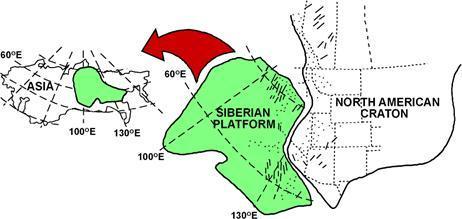
As far as the specific geological/tectonic context is concerned, it appears that the Belt Supergroup sediments were deposited in a deep gash at the edge of the North American craton, produced as some other continental block, possibly the Siberian craton, rifted away from North America’s western margin in a manner similar to that proposed by Don Winston of the University of Montana in the left panel below. Again, I take this to have occurred early on Day 3 of Creation Week.